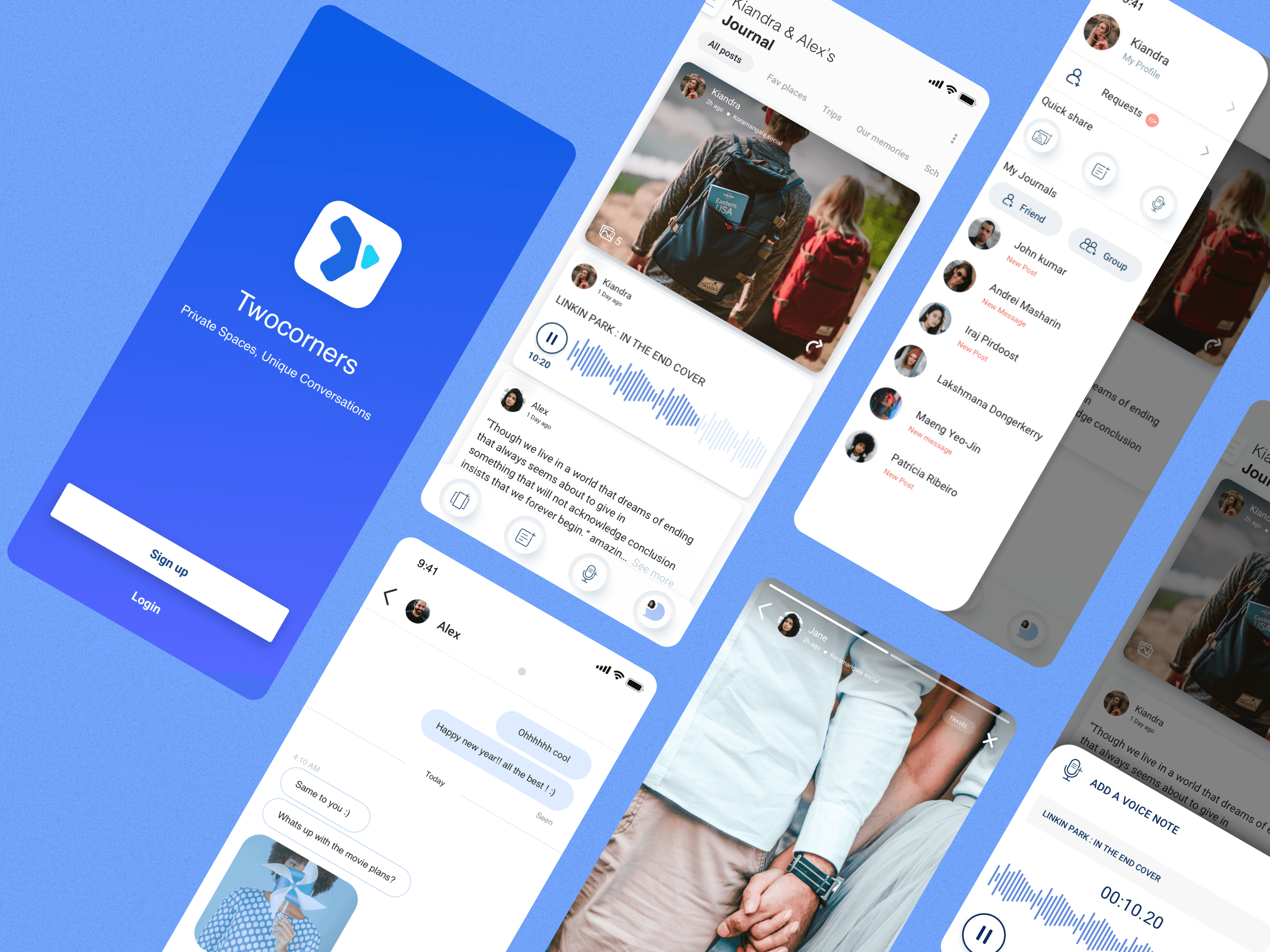
A private alternative to social media
Twocorners began during COVID, when three friends and I started questioning what social products had become. Public feeds were built around reach, reactions and endless content. Messaging apps were useful in the moment, but poor at preserving the photos, conversations and small memories people wanted to return to.
We saw an opportunity between those behaviours: a private space shared by two people. One person created a journal and invited someone close to them. Inside it, they could post, talk and collect the things that belonged to that relationship. There were no likes, comments, view counts or public audience.
The wider idea could work for close friends and family, but we designed primarily for couples. That focus gave the product a clear emotional centre: this was not another way to broadcast a life; it was a place to build a record of a life shared with someone else.
I was a co-founder and CEO, responsible for product direction, product management and the interface design in Figma. I worked alongside Selvaraj Kalimuthu, Mahesh Nandam and Ketan Ravindra, whose experience covered engineering, mobile products and operations. The four of us worked on Twocorners part-time around our full-time roles; the app itself was implemented in Ruby and React Native.
Designing around what people wanted to keep
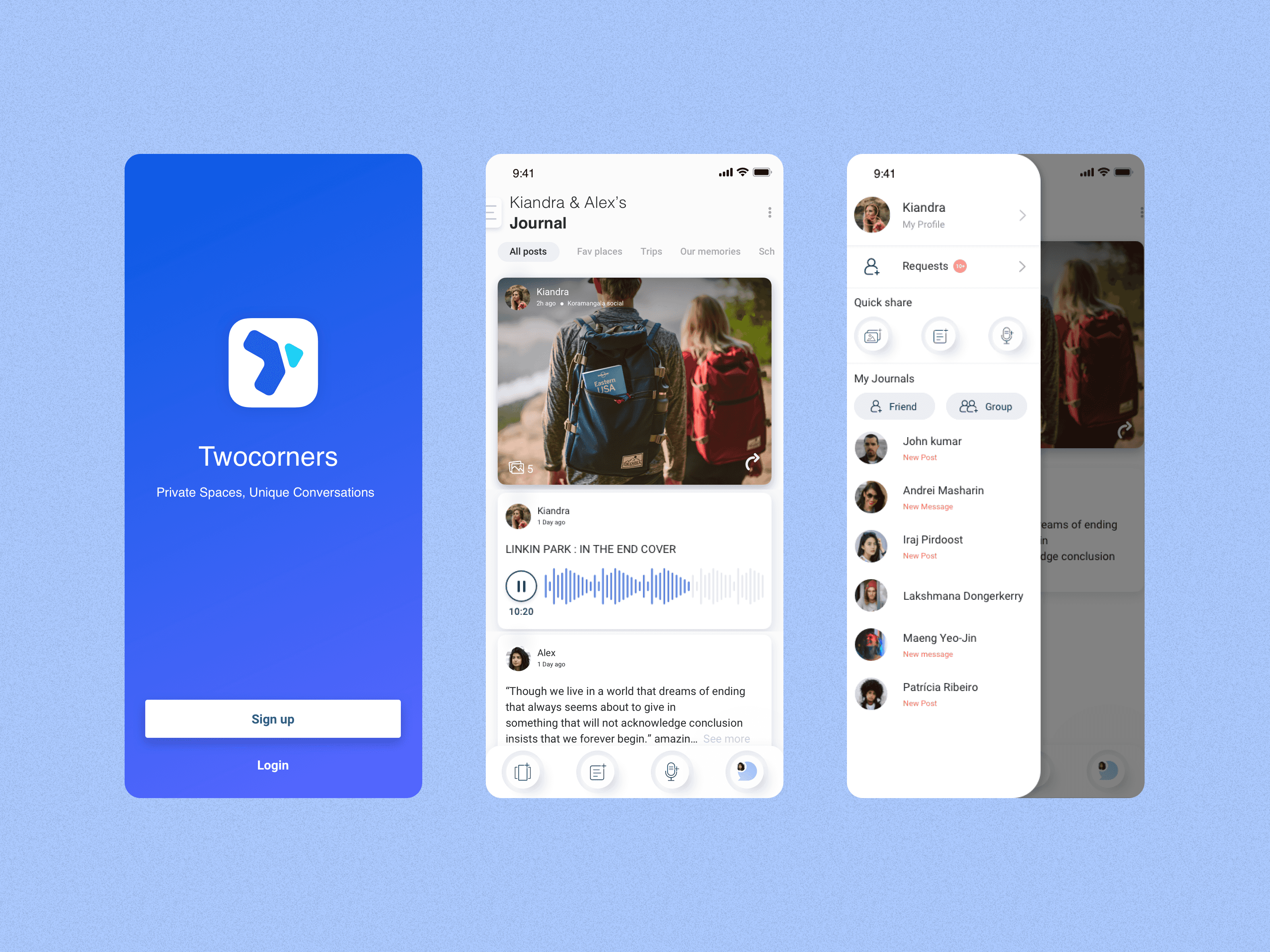
A smaller audience alone would still have produced another social feed. A journal needed to feel persistent and personal: a place for photos, notes, music, links and conversations that gained meaning because the same two people kept adding to it over time.
That principle shaped the information architecture. The relationship was always the context, and each post became part of its history. Content was not ranked for engagement or mixed with updates from everyone else.
The journal also gave different kinds of memories equal weight. A photo could sit beside a written thought, a song or a voice note without one format feeling secondary to another.
From a moment to a journal entry
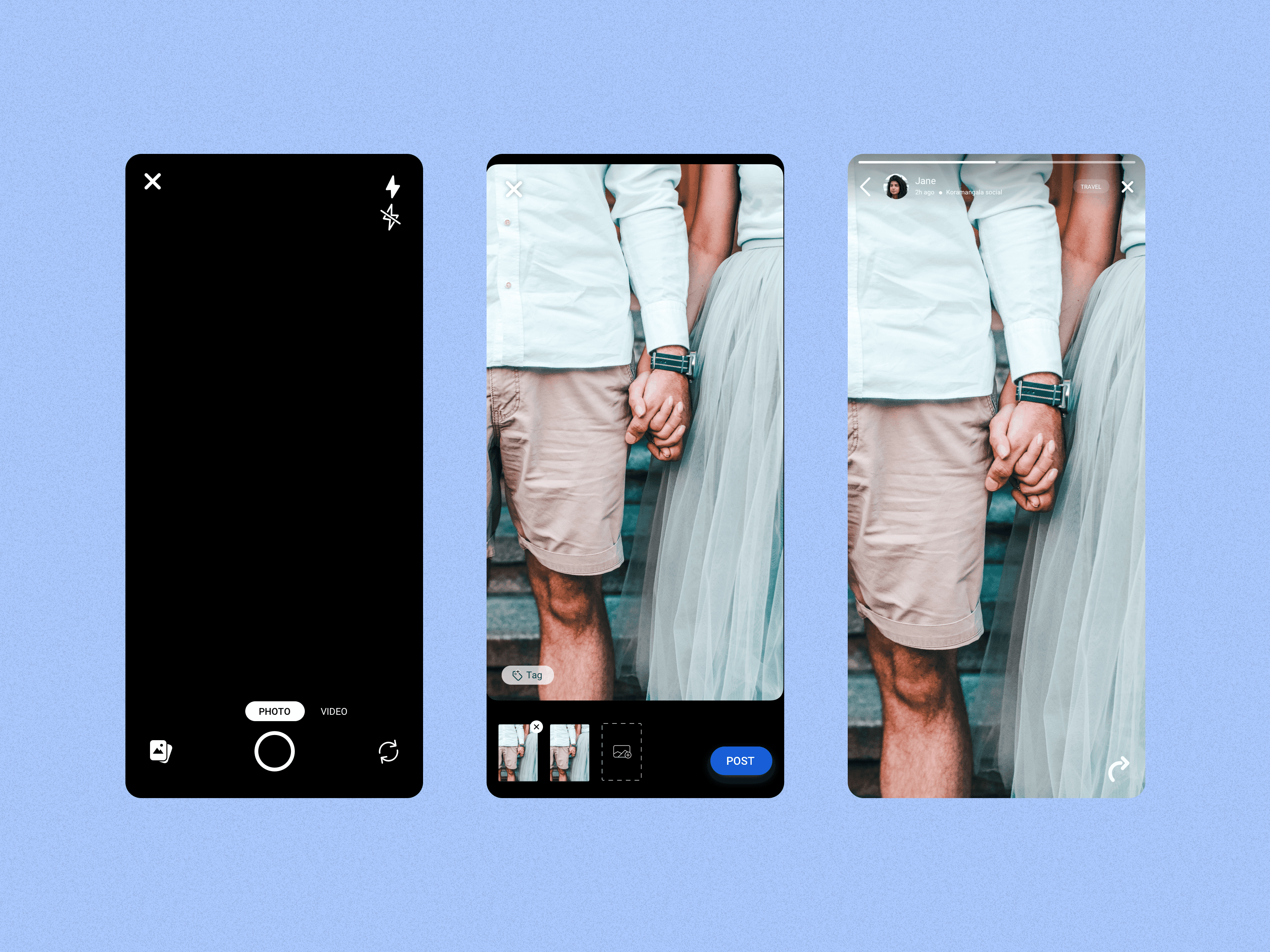
Sharing needed to feel as immediate as chat while still producing something worth keeping. The camera flow therefore stayed deliberately short: take a photo, review the set and share it to the journal.
People could remove a frame, add another or tag the moment, but they did not have to compose a public-facing post. Once shared, the photos were presented as a story, giving an everyday capture enough structure to feel considered without asking for more work.
Keeping conversation and memory distinct
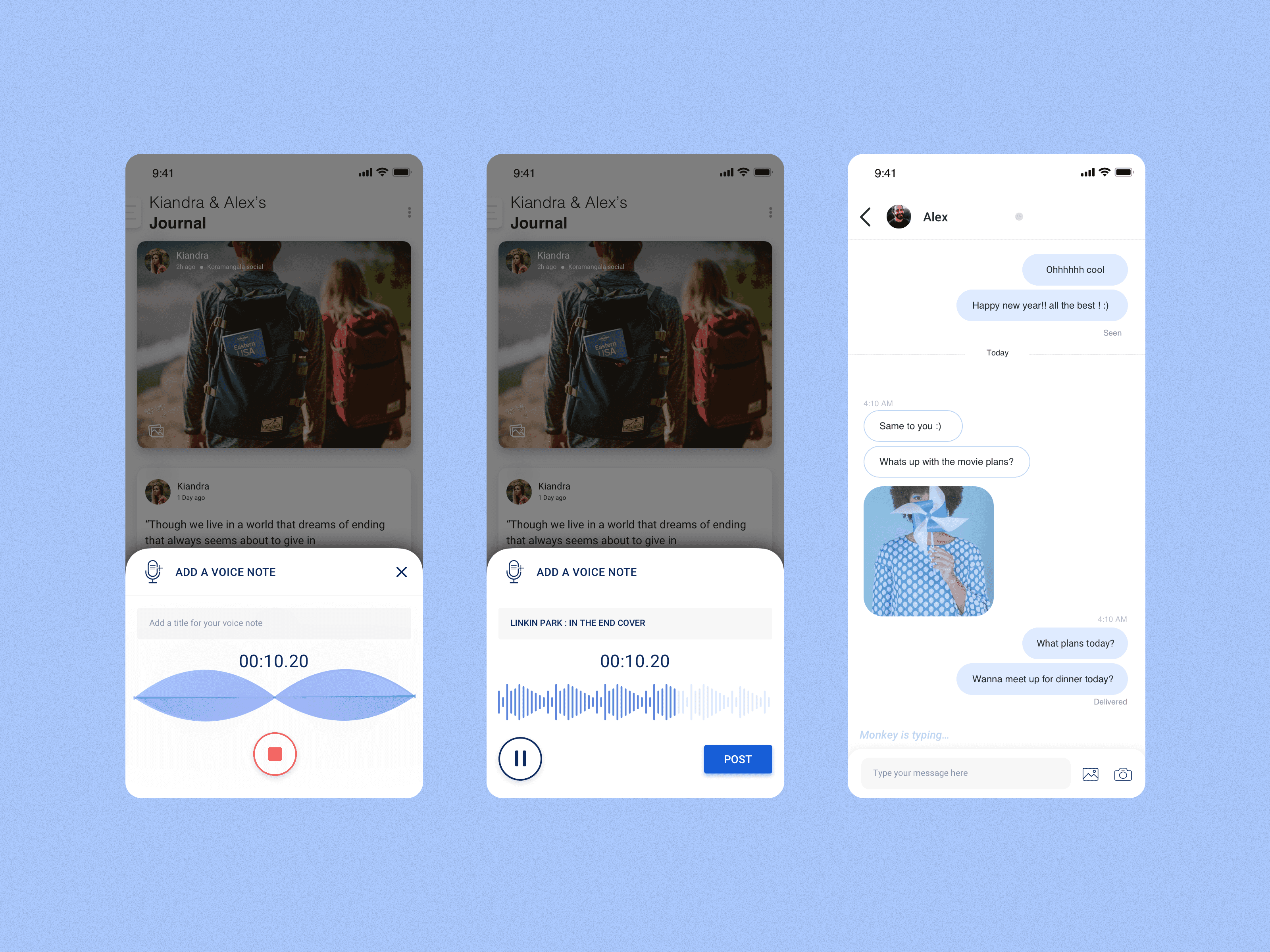
Not every memory starts with a camera. Sometimes a person's voice carries more of a moment than a photo or paragraph can. The recording flow gave voice notes the same care as visual posts: a clear recording state, playback before sharing, a title and a visible waveform in the journal.
Chat served a different purpose. It handled the conversation happening now; the journal held what both people chose to keep. We also explored a way to save important conversations, so they would not disappear inside months of message history.
A broader platform, with a deliberate boundary
The pitch deck made one boundary explicit: advertising would not appear inside private journals. We explored a wider product around them instead, with channels for media people followed and partner micro-apps for occasional tasks such as booking tickets, ordering food or arranging travel.
The intended model was to earn commission from transactions in those micro-apps while keeping the journal itself focused and private. It was an ambitious platform strategy, not a revenue model we proved at scale, but the separation mattered: monetisation should not compromise the part of the product built around trust.
From development to launch
Work began in November 2020. We completed the first phase in December, started alpha testing in January 2021, completed phase two in March and launched the India MVP in April. Version one followed in December 2021.
Building part-time made progress slower, but we did ship. Twocorners ran for roughly a year and reached around 1,000 members. We ran ads and demonstrated the product directly to couples. People understood the idea and often liked it when they saw it, but that interest did not consistently become an ongoing habit.
What the project taught me
The interface was not the hardest part, and a polished product did not solve distribution or product-market fit. Without the retention we needed, we could not raise the funding required to continue and eventually shut the product down.
Twocorners changed how I think about early products. A clear proposition and a well-made experience can earn attention, but they do not automatically create a reason to return. Today I would test that recurring behaviour much earlier: not only whether people liked the idea, but what specific behaviour would bring both of them back to the same journal week after week.